



By Kimberly Gasuras
Brandy Robertson is one of many business owners who wants more information when it comes to legalities concerning service dogs and emotional support dogs.
“I have a few clients that bring their dogs into the shop,” Robertson said during the service dog presentation at the Bucyrus Public Library on Tuesday evening.
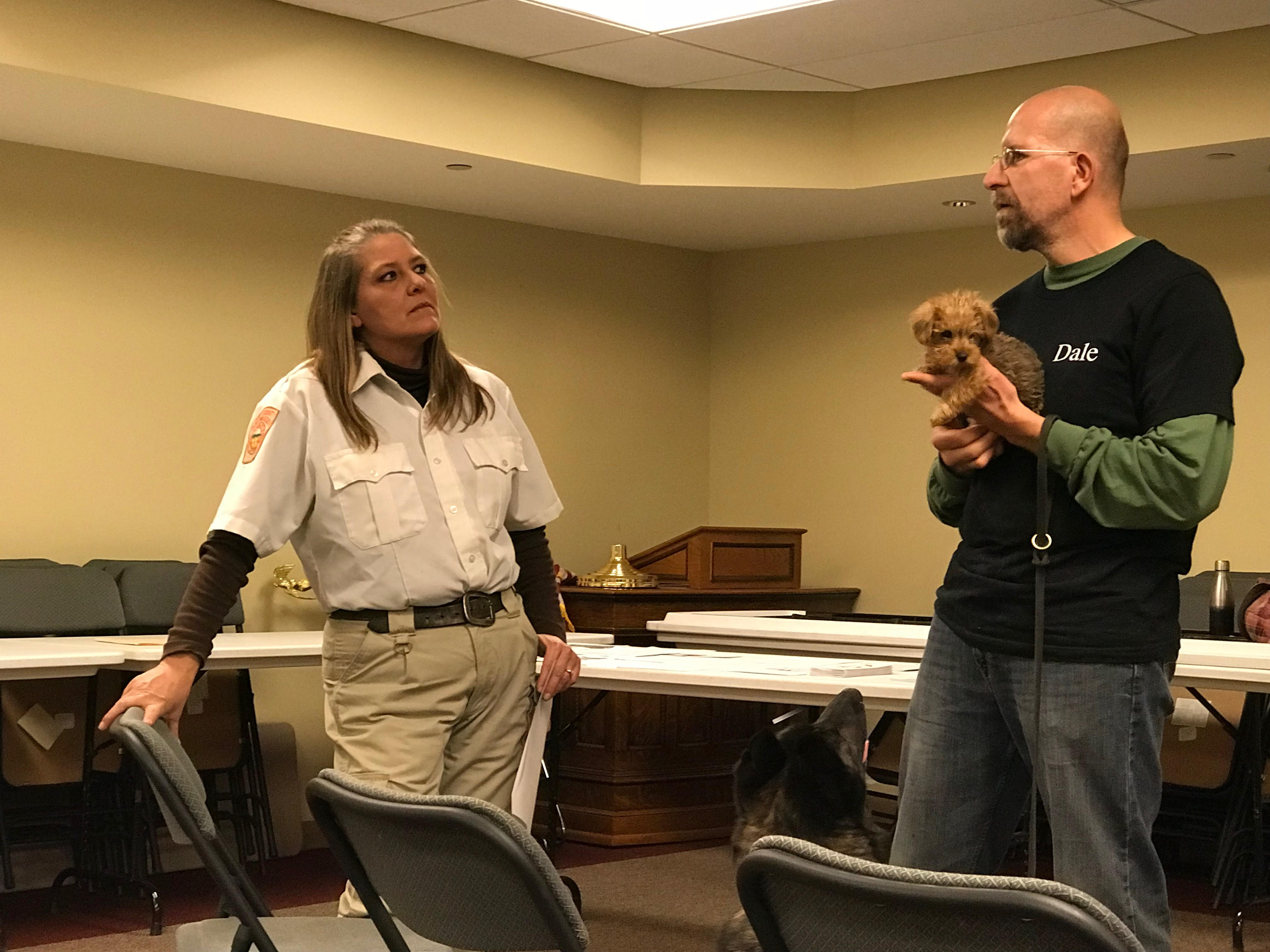
Crawford County Dog Warden Angie Chandler and dog trainer Dale Thompson headed up the presentation.
“There is a difference between emotional support dogs and service dogs,” Chandler said. “Service dogs are permitted in businesses under the law.”
Chandler said business owners can only ask two questions: Is the dog a service animal required because of a disability and what work or task has the dog been trained to perform?
Chandler said that the dog owner cannot be asked what their specific disability is that requires the assistance from the service dog.
She said a service dog is specifically trained to help people who have disabilities including visual impairment, hearing impairments, mental illnesses (such as post-traumatic stress disorder), seizure disorder, mobility impairment and diabetes.
According to the American Disability Act (ADA), no questions may be asked if the task the dog performs is obvious like in the case of a sight dog for a blind person.
Chandler stressed that an emotional support dog is not a service dog.
“The dog must perform a task for its owner,” Chandler said.

Service dogs must be permitted into businesses, including restaurants and grocery stores, while emotional support dogs are not.
Thompson said emotional support dogs provide comfort for their owner.
“They are needed to make the person feel more comfortable, but are not required to perform a specific task so they are not considered a service dog,” Thompson said.
Shelli Hines needs her service dog for stability after major back surgery.
“Gracie also picks up items for me that are on the floor or a low shelf,” Hines said.
Thompson trained Hines’ golden retriever to perform tasks for Hines.
Hines’ six-year-old granddaughter, Ariana, is on the high-end of the Autism spectrum.
“She needs her service dog to keep her focused, bring her out of a meltdown and to locate her if she wanders off,” Ariana’s mom, Nicole McCarthy, said.
Thompson said that there are rules pertaining to service dogs.
“The dog must be on a leash with a collar and under the control of its handler,” Thompson said. “At a restaurant, the dog can accompany its handler to the salad bar or food prep area but must stay on the floor. At the table, the dog must be on the floor and cannot eat from the table.”
Thompson also said that the dog must leave a business if it is being disruptive.
Even small dogs may become service dogs as in the case of Boris, a mini-Yorkie and mini-Dachshund mix, that Thompson currently is training for a man that suffers from cerebral palsy.
“He will focus on Boris while he is in therapy and his legs are being stretched out. Boris will keep him calm and focused so he can withstand the therapy,” Thompson said.
Although certifications are not available for service dogs, it is something that Thompson’s organization, Pound to Service Dogs, and several others are working on.
For more information about service dogs, visit https://www.ada.gov/regs2010/service_animal_qa.html.