


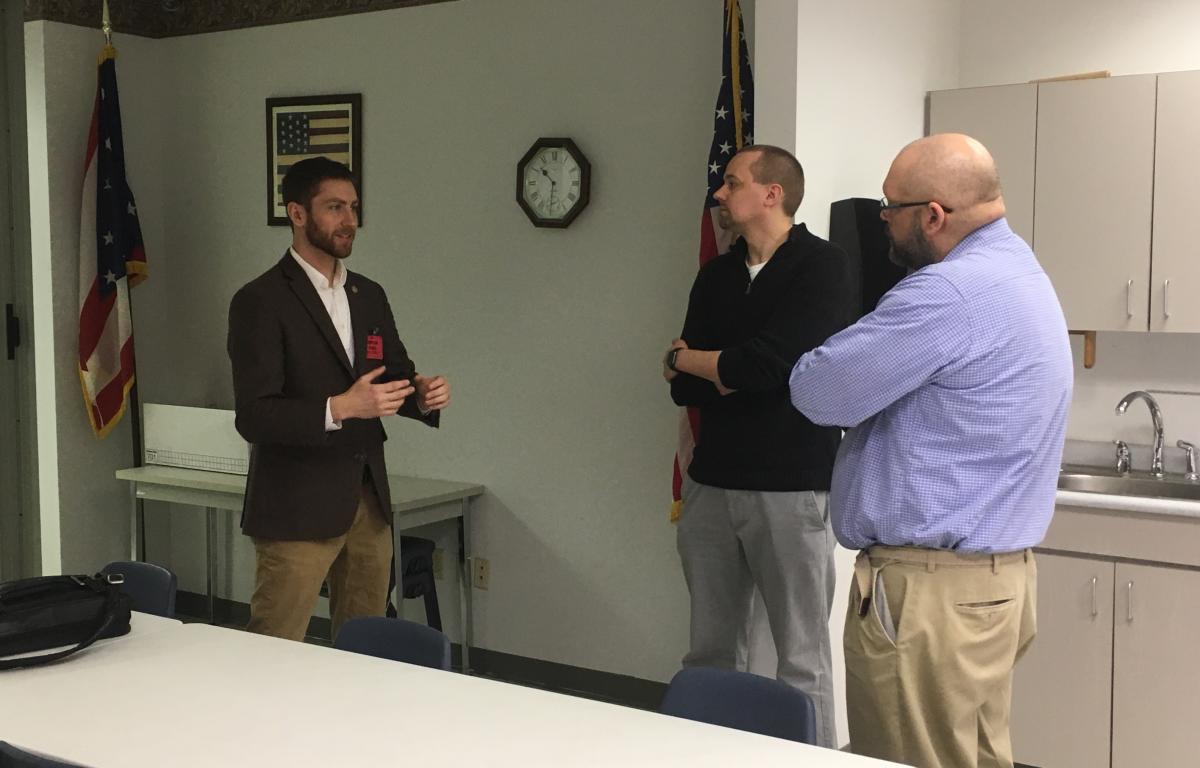

BUCYRUS — Rep. Riordan McClain (R-Upper Sandusky), of the 87th District of the Ohio House of Representatives, recently traveled to Bucyrus to meet with the staff and administration of Crawford County Job and Family Services.
McClain said it is important for him to meet with those at the county level to find out how operations are going at the ground level of his five-county district.
“It’s very important to me, specifically as a relatively new legislator down in Columbus,” McClain said. “I’ve been in a year and I’m still wrapping my head around everything from the ground level and hearing what is functioning well in terms of state involvement with all the local entities as well as what can be improved upon.”
Crawford County JFS Director Cassandra Holtzmann said the visit was a boost for her staff.
“We were so excited that he was coming,” Holtzmann said. “I think when a legislator takes that kind of time, they want to know what’s going on, they want to learn about the programs they are making legislation on, it’s huge for us.
“I think for (the staff), they see someone important, who is coming in from Columbus, who comes to check out what we do, it makes them feel valued.”
The youth served by JFS was a main topic of discussion throughout McClain’s tour of all the departments inside JFS.
McClain said early intervention is a high priority for him when it comes to youth, especially at-risk youth. He said, now, with a governor who McClain said is really focusing on the first five years of life, assisting the youth in the right way is a top concern.
“Whether its workforce or drugs, they all play a factor and it all goes back to how our youth is raised and what we invest in them,” McClain said.
Holtzmann agreed that the youth, and helping young people early, are main priorities.
“If we don’t start early, the cards are really stacked against some of the youth that we work with,” Holtzmann said. “If we spend some time focusing on them now, we’re going to have a much more productive citizen moving forward, and we’re not going to have the outlay of expense in the criminal justice system.”
With a background in the private business sector, McClain said he wants to also focus on the efficiency of the money being put into different programs.
“Making sure we are putting those resources in the right place is something I’m committed to doing,” McClain said. “Spending money wisely, making sure we’re efficient, because throwing money at a problem is not always the right answer, it’s about spending that wisely.
“For me, getting information and statistics at the ground level is key.”
That is exactly what Holtzmann hoped McClain took away from the visit.
“We have to be able to help each other out,” Holztmann said. “There are some areas we are adequate with our funding, we’re fine with it. It’s how we run those programs.”
She also said she was glad McClain was able to meet with the staff and “faces behind the dollars and programs.” McClain even was able to meet a foster couple and hear their concerns as well as what they thought worked well.
The couple discussed how the biological families are, at times the largest road blocks to giving the child a healthy life. Routine disruptions in the reunification or adoption cycles also were mentioned throughout the tour as a hardship for the department.
McClain, who recently was appointed to the Ohio Commission on Fatherhood, said he is pro-parental rights, but said it needs to be reevaluated where that line is to keep biological parents from abusing the system.
He also was informed about the 78 juveniles in the county’s custody, 38 of whom are in permanent custody of the county, are providing a large caseload on the JFS case workers.
Holztmann said the newest case worker at JFS has 15 cases when the recommended per case worker is approximately 12. That employee has the lowest number of cases on staff.
McClain said his next step is to talk to other legislators in Columbus and compare successes and failures.
“How can we bring the things that are working well across the state and maybe cut away the things that aren’t working well,” he said. “A lot of that is local, but there are things that can be leveraged across district lines to work collaboratively.”