


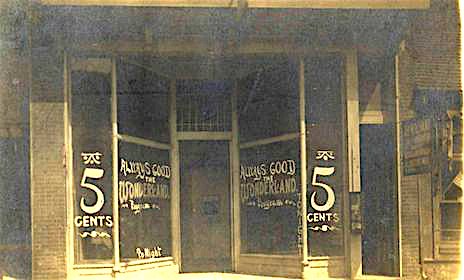

126 and 130 South Sandusky Avenue
The buildings at 126 and 130 South Sandusky Avenue are best understood together. While modern street numbers encourage us to think of them as separate, the newspapers tell a different story. One of shared attention, overlapping uses, and a downtown block that functioned as an ecosystem rather than a set of sealed containers. Over time, these neighboring storefronts absorbed many of the same economic and cultural shifts, even as their individual paths eventually diverged.
Setting the Stage: Retail Takes Hold
By the late nineteenth century, both buildings were already woven into the commercial life of Bucyrus. At 126 South Sandusky, L. Thurman, a hatter and men’s furnisher, anchored the space firmly in traditional retail. Just a few steps away, 130 South Sandusky hosted J. Herskowitz, whose dramatic dry‑goods advertisements promised “Some Startling Revelations” and the sacrifice of $25,000 worth of stock. Shortly afterward, Sam Nathan, clothier and furnisher, followed with his famously exuberant “WAIT! WAIT! WAIT!” headline, promising a “mammoth establishment” and treating the opening as a civic occasion.
Together, these early uses establish the character of this part of South Sandusky: conspicuous, competitive, and expectant of foot traffic.
Early Twentieth‑Century Flexibility
As the twentieth century began, 130 South Sandusky began to pivot noticeably. S. Heinlen’s feed store relocated practical, agricultural commerce into a space once defined by fashion and spectacle. At roughly the same time, both buildings enter a period where the precise boundaries between storefronts become harder to see in the record.
At 126, advertisements associate Hart Brothers with a piano sales room, suggesting a space used for promotion and display rather than long‑term occupation. At 130, the W. W. Kimball Piano Company conducted a manufacturer’s sale, bringing in an entire carload of instruments. These announcements appear close together in time, hinting that music‑related businesses were not isolated occurrences but part of a broader downtown moment.
The Nickelodeon Era and Blurred Space
By the first decades of the 1900s, the block entered the nickelodeon era, when entertainment, leisure, and short‑term ventures flourished. Newspaper stories increasingly referenced the nearby Wonderland Theatre, but often without cleanly separating which activities took place inside which building. Fires, explosions, openings, and final performances are reported as happening above, behind, or near the theatre, and businesses are similarly described as occupying rear rooms or upper floors.
Fun fact: The word nickelodeon comes from the price of admission—a nickel—and the Greek word odeon, meaning theater.
This is where 126 South Sandusky becomes especially difficult to isolate. Small ventures—dry cleaning operations, workshops, and a candy kitchen—appear in the same geographic orbit, but are rarely tied conclusively to a single address. Some of this activity may have taken place within 126; some may have shared connected or subdivided interiors with neighboring buildings, including 130. The newspapers assume readers understand the layout and offer little clarification for later historians.
Meanwhile, 130 South Sandusky hosted Miss A. Lauterbach, a Chicago scalp specialist offering hair and facial treatments, followed by The Recreation, a billiard and pool parlor advertising itself as “Bucyrus’ Best Bet.” Entertainment here was loud and visible, while at 126 it was more often implied, absorbed, or happening just out of clear view.
Diverging Paths, Shared Block
By the 1930s, the two buildings begin to differentiate more sharply. 130 South Sandusky becomes a hub for national chains and mixed‑use occupancy. F. W. Woolworth Co. opened its five‑and‑ten‑cent store there, followed later by Seegel’s Shoe Store, which advertised itself as next to Woolworth, and the Sears, Roebuck & Co. catalog sales office, which operated for several decades. Professional services such as W. M. Chapman’s chiropractic practice and Allstate Insurance appear during the same period, likely occupying upstairs or rear space.
At 126 South Sandusky, clarity finally arrives with Struble’s Drug Store. By the early 1940s, Struble’s is unmistakably tied to the address and remains for decades as a Walgreens agency, complete with a soda fountain. Newspaper articles describe significant remodeling and expansion projects, helping explain why earlier uses were so difficult to map: the building’s footprint was not static and gradually absorbed more space.
Mid‑Century Change and Late‑Century Transition
The postwar decades maintained these trends. 130 South Sandusky adapted to the automobile age with Moore’s Store / Moore’s Tires, then shifted again into fashion retail with the Ruth E. Ball Shop and Ada’s Fashion Gallery. Ada’s became a key reference point, as later tenants consistently described their location as formerly Ada’s Fashion Gallery.
At 126, Struble’s tenure came to an end in the early 1970s, opening the door to the building’s modern chapter.
The Present Comes Into Focus
In the early 1970s, Lee’s Shoes announced a move into the former Struble Drug Store at 126 South Sandusky Avenue, first through a large Moving Sale advertisement and then with a celebratory “NEW! NEW! NEW!” opening notice. From that point forward, 126 finally settles into a clear and enduring identity. What had once been an ambiguous participant in a busy downtown orbit becomes easy to name and easy to recognize.
Meanwhile, 130 South Sandusky moved fully into professional use. After Symphonic Hearing Aid Center and Claims Processing Network, the building became home to Nationwide Insurance, first under Leslie “Bud” and Carole Schiefer, and later continuing as Nationwide Insurance – the Andrew Schoch Agency, its current occupant.
Two Buildings, One Story
Seen together, 126 and 130 South Sandusky tell a single story with two endings. For decades, their boundaries blur in the newspapers, reflecting a downtown that was busy, adaptive, and unconcerned with strict spatial precision. Over time, each building settles in its own way—126 into long‑term retail with Lee’s Comfort Shoes, and 130 into stable professional offices with Nationwide Insurance.
What unites them is less their tenants than their role: flexible spaces at the center of town, continually reshaped by what Bucyrus needed most at each moment. Their shared history reveals not confusion, but vitality and a downtown that was always in motion.
*photos are from Bucyrus Historical Society Facebook
126 South Sandusky Avenue


130 South Sandusky Avenue


