



By Kathy Laird
CCN Correspondent
A former Bucyrus resident, traveled back to Crawford County Common Pleas Court from Kentucky to attend a hearing asking Common Pleas Court Judge Sean Leuthold to seal his criminal record.
Eric McMahon, 50, of Burlington, Kentucky filed a request to have the felony charges on his criminal record sealed.
Leuthold originally denied the request without a hearing. McMahon appealed his case to the third district of appeals where the court ruled that McMahon was entitled to a hearing to argue why it would be more beneficial for his record to be expunged rather than having the state keep his criminal violations a matter of public record. McMahon took a plea deal in which the charge of disseminating matter harmful to a juvenile was reduced to a charge of telecommunications harassment.
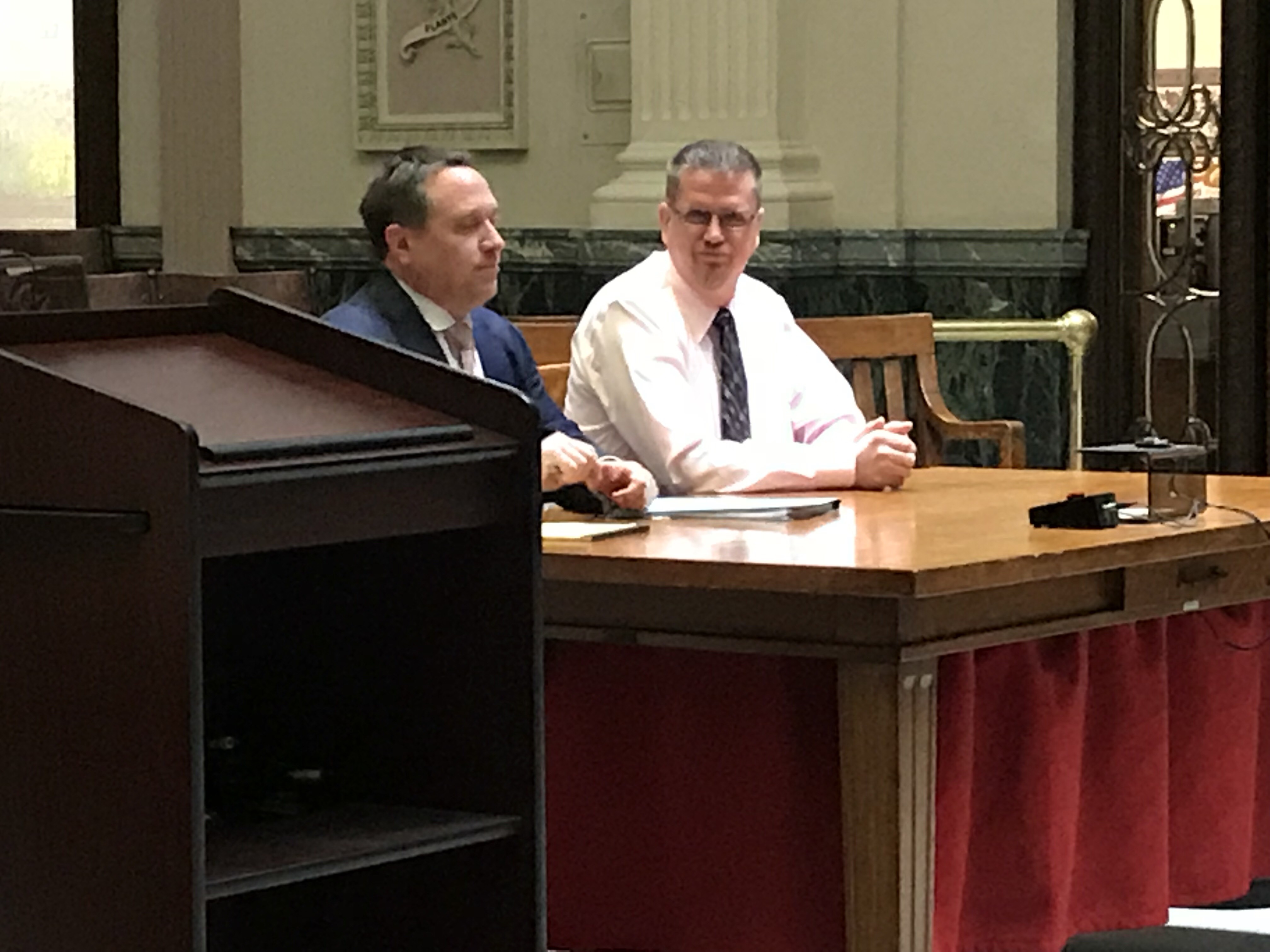
McMahon was present with his attorney, Ryan Probst, of Columbus. Probst helped negotiate the reduced charges.
Leuthold, noting that neither he or current assistant prosecutor Ryan Hoovler worked on McMahon’s case, allowed both sides to argue their point. Leuthold noted that it was each party’s responsibility to make arguments on to support their position on the expungement.
Probst spoke on behalf of his client noting that McMahon’s need to have the records expunged outweighed the state’s need to keep them public. Claiming his client had not been in any additional trouble since the incident, he shared that his client successfully completed the one-year probation that was imposed.
He said his client now resides in Kentucky where he works two jobs; one as an Envoy for a subsidiary of American Airlines and the other as a Shuttle Driver for the Hilton Hotel. Probst went on to explain that the felony convictions had prevented his client from advancing in his employment because he had been denied better paying positions. He told the court that his client had been denied access to good housing because of the conviction.
McMahon recently filed bankruptcy, had his car repossessed and a second marriage failed. Probst said that McMahon had been isolated from his children, and noted his client was very ashamed of his past actions and was remorseful.
“How long does a person have to carry this kind of conviction?” Probst asked.
Leuthold questioned McMahon about his current salary and how much more he would be able to make without a conviction on his record.
“I’m going to be very blunt here,” Leuthold said. “These kinds of charges do carry a stigma; but then you committed a sexually motivated offense. The plea agreement you received makes this charge look like much less than it is.”
When asked if his ex-wife used the conviction to turn the children against him, McMahon said that his recent divorce was from his second wife who worked at Delta Airlines with him. McMahon explained to the court that he worked with a bailiff’s wife. He had recognized McMahon and told the bailiff’s wife about the case. She came to work the next day at Delta and told people that she worked with about his history. His wife divorced him and transferred to another Delta location. McMahon was close to tears as he testified that he could not have made it through this difficult time without the support of his parents.
Assistant Prosecutor Ryan Hoovler presented the State’s objections to the expungement.
Hoovler had Eric Bohach explain to the court his connection to the case. In 2011, Bohach was a police detective working in Yahoo chat rooms to seek out men looking to become involved with young girls. Bohach said that McMahon had several conversations with him, but McMahon believed he was talking to a 15-year-old girl. As the conversations progressed they became more sexual in nature. Bohach said that McMahon had a webcam attached to his computer and on two different occasions videoed himself masturbating for the girl. He also indicated he wanted to take pictures of the girl and her friends and to go skinny-dipping with her.
Following Bohach’s testimony Hoovler told the court that the plea was pure legal fiction contrived to get a plea deal; one, which at some point, could include expungement.
Hoovler told the court; “Maybe it’s a good thing that Mr. McMahon didn’t get that job where he might come in contact with young girls. Maybe it’s a good thing he couldn’t move into that neighborhood.”
Hoovler said it was too early for an expungement.
Before rendering his decision, Leuthold said it was his job to decide who benefits more from the expungement. Leuthold noted that it was clear the conviction had an impact on McMahon’s life.
“In the interest of the public I must decide if there is a benefit to the public knowing this information,” Leuthold said.
Noting that the ideal case for expungement includes a long history of behavior after the conviction, the type of offense and the age at which it was committed.
“In a perfect case, the applicant would have twenty years of good behavior behind them. They would have committed crimes that do not involve the public safety,” Leuthold said.
Noting that McMahon was 44 at the time of the incident and now is 50, Leuthold said this was not an act of a young man.
Directing his attention toward Probst, Leuthold asked the attorney, “If I wipe this clean today, who’s to say that he couldn’t go get a job at a school where he is exposed to young girls. Don’t you think the school or other employer has a right to know about his history?”
Probst replied; “My client would never take a job at a school as it would be a step down for him.”
“These charges are not legal fiction, they are not innocuous. On the spectrum of crime, this is pretty high up there,” Leuthold said.
Probst responded to Leuthold saying; “There are always going to be hypotheticals, we could argue those same ones 20 years from now. My client has no other criminal history.”
Before rendering his decision, Leuthold did commend McMahon for coming back to face the situation. He noted that the felony has affected his life. He told McMahon that his conviction would be hard on any marriage.
“There are certain types of felonies that should not be expunged. You must be prevented from taking a job with access to underage girls and anyone attempting to hire you has the right to know about your past history,” Leuthold said.
Based on the seriousness of the offenses and the minimal amount of time that has passed since the conviction, in Leuthold’s opinion, the court denied McMahon’s motion for expungement based on the record.