


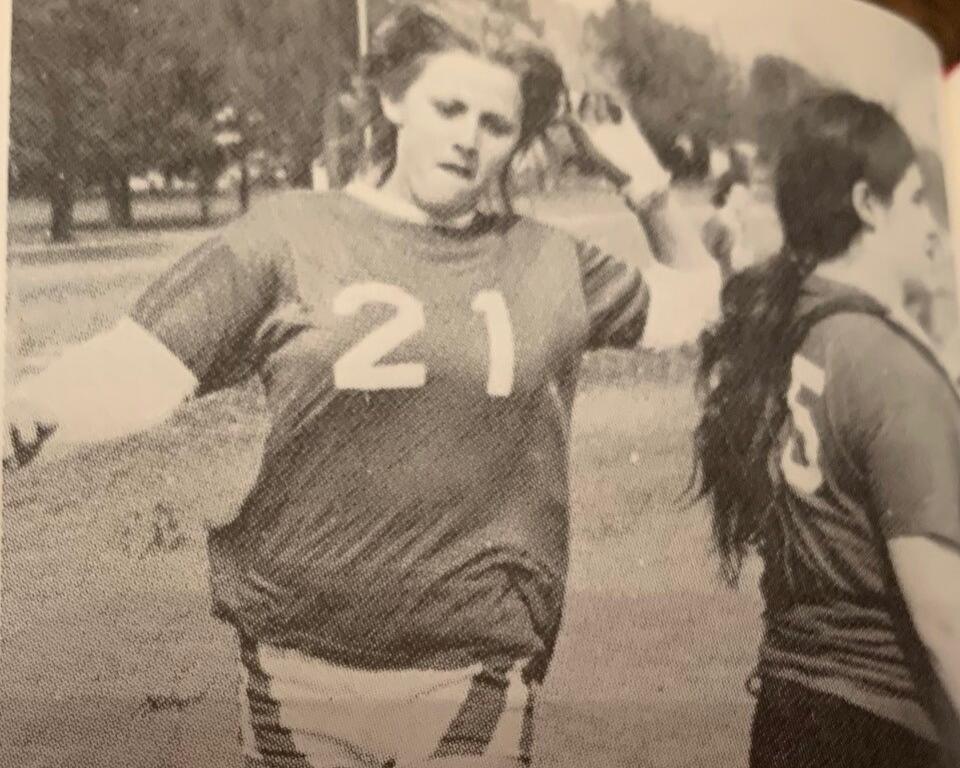

BUCYRUS — Tami (Wolf) Tima remembers her first softball season at Bucyrus High School. It was 1974 and she was a sophomore wanting more competition.
“Girls were trying to get into sports more. I was involved through the GAA (Girls Athletic Association) and track also was going on. But we wanted to play softball,” Tima said.
Few records were kept, but girls at Bucyrus began playing softball as far back as the 1960s, with a picture even appearing in the 1966 yearbook.
Creation of Title IX
It should be noted there were a limited number of Ohio schools fielding softball teams in the mid-1970s. The first state-sponsored tournament was in 1978, with the first season competing for league awards wasn’t until 1981.
At that time not all area schools had teams. But Mohawk, Buckeye Central, Bettsville, New Riegel, Seneca East, and Colonel Crawford also did.
In 1972, federal legislation called The Education Amendment Act was signed into law by President Richard Nixon. This opened the door to girls sports across the country.
Title IX of that law recognized education as an equal right for all. Within the title, there was a clause “prohibiting gender-based discrimination in sports programs, granting equal opportunity to both men and women to participate in sports.”
From there, girls sports in Ohio and across the nation took off, with thousands of young women competing. Today an estimated 362,000 high school girls play organized softball.
Rough beginning
“A few of us went to Jack Binnix (the athletic director) and we said we gotta get this going. I said, ‘Yeah, but where are we going to play? There’s no (playing) field.’ There was a field right where the girls play now.
“We were sitting in study hall and I can still see him coming in with metal buckets. He goes, ‘if you girls want a team, you girls want a field, here you go. Go out there and start picking up them rocks’ — and that’s exactly what we did.
“We cleaned up it and when he saw we were really interested, he helped us get it going,” Tima said.
Kathy Leitzy was the Bucyrus coach and the team won four of its five games. It lost in the season finale to Mohawk, according to “Redmen Review,” the sports history book compiled and written by James W. Grandy.
Sue Banks was the pitcher with Rosie Barciz and Wolf catching. Outfielders were Mary Dunham, Holly Felkey, and Connie Sharp.
Kathy Sipes handled first base, Candy Weinandy second base, Terry Monroe at shortstop and Wolf at third base. Other members included Torra Frizell, Kathy Shuck, Dawn Striker, and Pam Studer for a roster numbering 13.
Wolf and Monroe were chosen co-captains.
‘No real uniforms’
“The field wasn’t in the best condition, but we didn’t care. We just wanted to play. I didn’t have the equipment. I did catch and I played third base. I was little,” Tima said.
“I wore volleyball knee pads for my shins because the shin guards were too big. We had masks, but they were nothing like what they have today.”
The pitching was strong that first season thanks in large part to Banks.
“Sue has passed away. But Sue could throw a ball. Oh my gosh, could she throw a ball. The biggest girl on the team pitched and the littlest girl on the team caught and it was lots of fun. We had a riot.”
Their attire was a bit different than today.
“We had shirts, but no real uniforms. No spikes, just rubber cleats at one time. We had stealing and sliding, of course. But there was no circle like they have … just the rubber piece where you pitched.”
There was just a bench and no dugouts.
“I think we had a fence, and I know we had a backstop,” Tima said.
“Kathy was just such a great coach and we had officials. At that time, you could not play two sports at Bucyrus. So, a lot of the girls who played softball with me during the summer were on the track team.”
The next year the interscholastic schedule was expanded to eight games.
The team went 5-3, with two of the losses coming to Mohawk. They defeated Mansfield Malabar and Colonel Crawford twice each and Ontario once.
“Back then it was a lot more boisterous. Anything to get them to swing. It was great. ‘Hey batter, batter, it’s coming to the inside. Swing.’ I played two years,” she said.
One other difference, Tima recalls vividly, is the color of the ball.
“We had a hard, white softball just like the men had. Now it’s yellow and it looks bigger too now,” Tima said.
“I also didn’t have a catcher’s mitt that fit. It was too big for me, so I used a regular glove when I caught. But I had no fear. Catch those pop-ups and throw somebody out.”
As a hitter, Tima focused on getting on base.
“I was always the first batter because I was fast. Just connect and you’ll beat it out, coach Leitzy would tell me,” she said.
Tima also played basketball as a freshman but wasn’t a point guard despite her diminutive stature. She was a defensive specialist and she also cheered for the Redmen.
Historical significance
Despite being pioneers at the time, the girls of that era weren’t really aware of the historical context. They just wanted to get on the diamond.
“It kind of is now. But back then, people didn’t stay in and watch TV. All we cared about was getting outside. We actually helped Wynford and Colonel Crawford get this stuff going because we wanted to play different teams,” Tima said.
Girls sports was just beginning and travel was limited.
“We didn’t have AAU and all that stuff. Mohawk was the farthest we went, I think. We didn’t even have a bus. I don’t know. Maybe Kathy took us in a van or something. It was fun and we were building. I would love to do it still.”
Tima later became the first female sportscaster on Bucyrus radio stations and operates Old Crawford Land Title Agency. Her charitable volunteering has been vast, including leading Bucyrus Rotary Club projects.
Helping others
But the foundation of that life of leadership was laid early while she was a high school student.
“I was a different child. I was always organizing things. If you’re gonna do something, do it yourself, and get it right. I didn’t really think about it until now, but I was part of getting it started. We all were.”
She has helped as a teacher’s aide and coached fifth- and sixth-grade girls basketball.
“I coached that to get it going. I think sports keeps kids out of trouble. But it’s a reward,” Tima said.
“You want to see the kids go out there and have a good time … and have sportsmanship. You don’t need the best equipment. Go play hard.”
State champs under Hewitt
Officially, Jack Hewitt was the head coach of the Redmen for just one season, 1990.
But that team went 27-2 and won the Division II state championship, beating Tallmadge, 2-1, at Brookside Park in Ashland. Bucyrus rode the pitching arm of Patty Surina, who went on to have a stellar career at the University of Akron.
The two losses came to Bellevue and Norwalk.
Hewitt’s presence remained for decades, and the current field was named after him in 2019. He was a pioneer, of sorts, in the softball arena. He taught others what he had taught himself.
“There were no books or films,” Hewitt said in a July 2015 interview with The Bucyrus Telegraph-Forum.
“You either picked it up or you didn’t. A lot of the drills I came up with myself. Now I see them in books. It took me 10 years to get a good understanding of pitching.”
Bucyrus, Crestline, and Colonel Crawford all won state titles in softball, due in no small part to Hewitt’s contributions.
“I went around to the other schools and put on clinics,” Hewitt said. “It wasn’t just Bucyrus girls I coached.”