


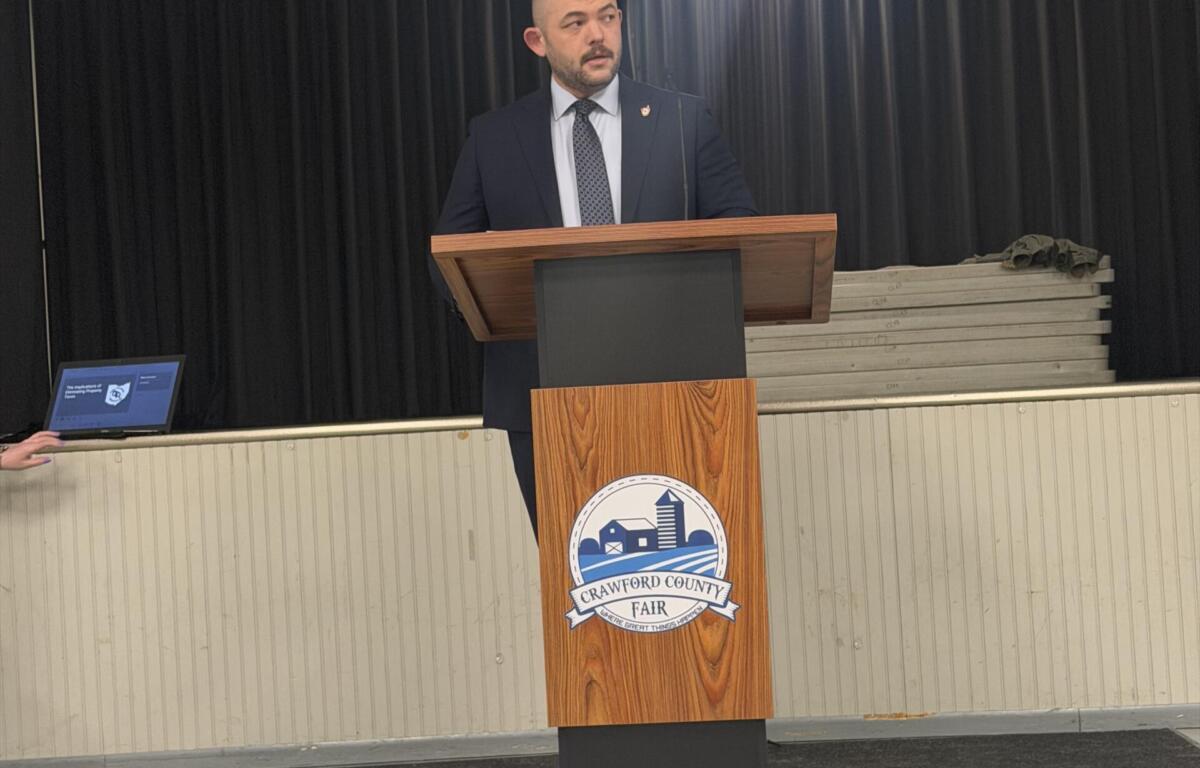

BUCYRUS, OH (CRAWFORD COUNTY NOW)—Kyle Brooks, director of governmental affairs with the Ohio Township Association, spoke to Crawford County residents last Tuesday evening about a proposal to eliminate property taxes in Ohio.
A small group in Lake County is attempting to place a constitutional amendment on the statewide ballot to repeal property taxes. To qualify, the group must collect 415,000 valid signatures from at least 44 of Ohio’s 88 counties. Each of those counties must contribute signatures equal to at least 5 percent of the votes cast for governor in the last election. Petitions are due July 1 for the amendment to appear on the November ballot.
Once submitted, the Secretary of State has 20 days to validate signatures. If the group falls short, it has 10 additional days to gather more. If the total is met, the state has 30 days after that to complete validation. If approved, the amendment would appear on the November ballot.
If the group misses the July 1 deadline, it may continue collecting signatures until July 1, 2027, for placement on the November 2027 ballot.
Brooks said only the organizer leading the effort knows how many signatures have been collected.
Break it down
Eliminating property taxes would remove $24 billion in annual revenue — the amount collected in 2024 — with no replacement funding plan. If approved, the repeal would take effect Jan. 1, just eight weeks after the election.
Based on the 2024 numbers in Ohio, these are the rough estimated totals to fund each section:
- $15.6 billion to schools
- $3.93 billion to the counties
- $1.75 billion to townships
- $1.55 billion to municipalities
- $1.5 billion to special districts (libraries, parks, DD boards, veteran services, etc.)
Ohio’s rainy-day fund holds about $2.5 billion, enough to cover roughly one month of expenses if property taxes disappeared.
Essential services — fire, EMS, police, roads, utilities, zoning, schools, senior services, sheriff’s offices, and more — rely heavily on property taxes. Brooks said many could face severe cuts or collapse.
Townships, which depend almost entirely on property taxes, could be forced to dissolve and be absorbed by nearby cities. Brooks said that in a hypothetical model, Ohio could effectively consolidate into Cleveland, Columbus, and Cincinnati — the cities with the strongest sales‑tax bases. Residents in absorbed areas would then pay those cities’ sales‑tax rates. Higher rates, he said, could drive small businesses out of operation.
The dissolution of townships would lead to fewer plows out when it snows to clear roads, and no township help in mowing ditches in the warm months, creating potentially dangerous situations at some intersections that have low visibility in either direction as is.
Volunteer fire departments and township EMS agencies would likely dissolve, Brooks said, increasing emergency response times from 10 minutes or less to 20–30 minutes or more, especially when city crews are already on calls.
Sheriff’s substations would be the sheriff only, if at all, due to a lack of funding. The question is also raised: where would those being housed in county jails go? Because without funding, those buildings can no longer be used.
The effect on education in Ohio could, and most likely would, have a serious negative effect.
Crawford County has six school districts, but should the property tax “demolition order” pass, it may have to go down to just one district and pick the five best buildings for kids to attend.
The teacher-to-student ratio would be severely affected, leading to less instructional and individualized support, leaving many at an educational disadvantage because the likelihood of the teacher having one-on-one time to help children who may need extra help would be much lower.
When it comes to transporting students, some students could see their bus times become closer to two hours in order to pick all the kids up and transport them to the necessary buildings.
Possible Effects/Solutions
To replace lost revenue, the state could raise income and sales taxes.
In Ohio, we currently have a 2.75% state income tax on taxable incomes from $26,051–$100,000, and Bucyrus city has a 2.25% income tax, Galion has a 2% income tax, New Washington has a 1.5% municipal income tax, and Crestline has a 2% municipal income tax.
Brooks said the state income‑tax rate could rise to 11–15 percent, and some counties could reach 20–27 percent. A household in Bucyrus city earning $40,000 could see its tax burden rise from $2,000 to $12,400.
Sales tax is another option. Ohio’s current rate is 5.75 percent and does not apply to groceries, off‑premises food, prescription drugs, utilities, and other items. Brooks said the rate could climb to 15–18 percent or even 20–25 percent. Another possibility is taxing all goods, similar to Florida.
Residents near state borders could shop elsewhere to avoid higher taxes, further reducing Ohio’s revenue.
Property taxes explained
According to the Tax Foundation, a property tax is primarily a tax on physical property, such as land, buildings, homes, and in some cases, tangible personal property like vehicles, machinery, or equipment. It is typically assessed by local governments, and the amount owed is based on the value of the property and the applicable tax rate, often expressed as a percentage or millage rate.
A mill equals one‑tenth of a cent, or $1 for every $1,000 of assessed value.
In Ohio, 100% of your property’s value isn’t taxed. It is taxed based on assessed value, and it is 35% of the appraised market value.
Brooks used the example of a house that is worth $200,000. The assessed value is $70,000 because it is 200,000 x 0.35 (35%) to equal $70,000. Then the millage of the house would be $70, because the value of the mill is $1 for every $1,000.
Ohio has inside and outside millage. Inside millage falls within the state’s 10‑mill constitutional limit and is allocated by the county budget commission, which includes the county prosecutor, auditor, and treasurer. Outside millage exceeds that limit and must be approved by voters.
House Bill 335, effective March 20, 2026, caps increases in inside millage at the federal inflation rate — 2.6 percent for 2026 — to stabilize tax bills in counties where property values have surged.
House Bill 309, the county budget commission bill, effective March 20, 2026, grants the county budget commission the authority to review and adjust the property tax levy collections if it determines a subdivision is collecting unnecessary or excessive funds based on spending and carryover balances.
Brooks cited an example from the meeting: A local subdivision passed a 5‑mill fire levy. Under the new law, the commission could review spending and carryover balances and reduce the levy if it determines the collection is excessive, even if voters approved it.
Brooks said the proposed property‑tax repeal — which he referred to as a “demolition order” — would be harmful to Ohio. Other states have considered similar measures, but none have passed them.
“I absolutely believe a reform of property taxes is necessary,” Brooks said. “Just not the repeal.”