



Disclaimer: Some content regarding this case may be sensitive to some readers due to the sexual nature of the alleged crime.
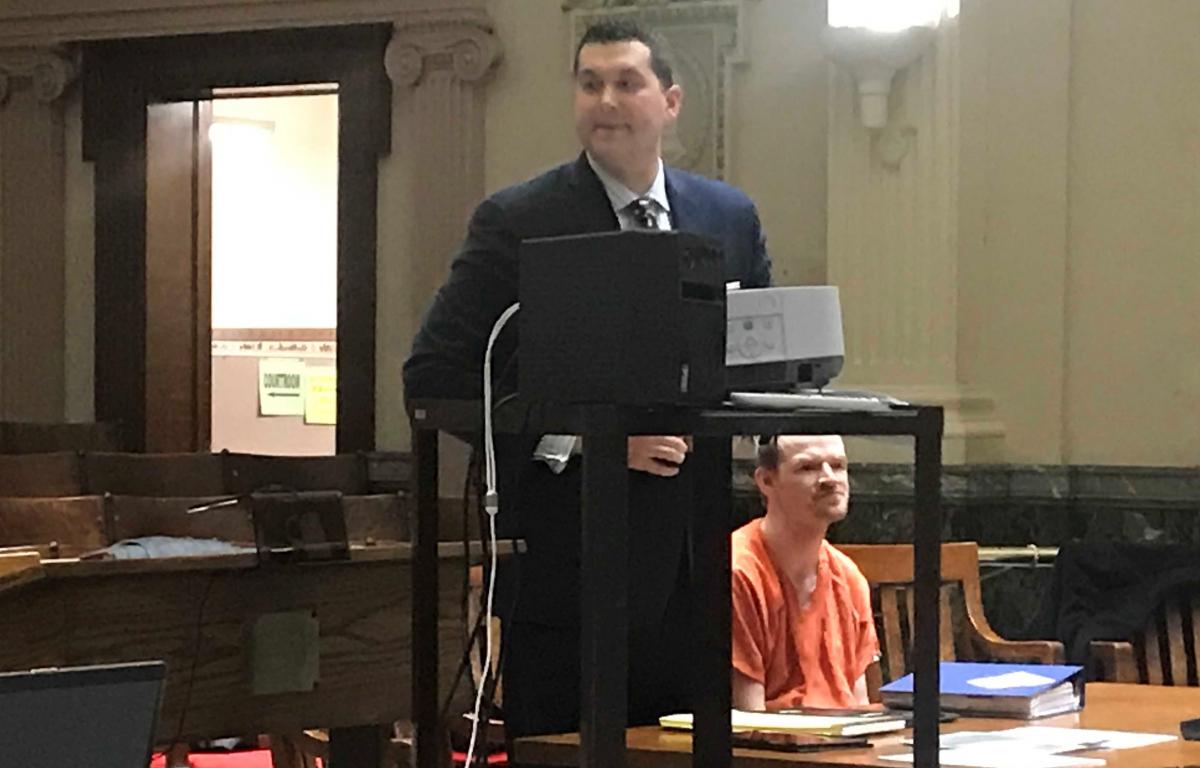
BUCYRUS — Adam Gunter, 39, of Galion appeared in Crawford County Common Pleas Court on Monday for a hearing to suppress comments made to Galion Police. Gunter is charged with rape, a first-degree felony.
According to the charges, Gunter assaulted a four-month-old baby he was left to babysit while the child’s guardian went to listen to karaoke music.
“I was trying to save her life,”
Gunter said.
Gunter’s attorney, Adam Stone, filed a motion to suppress Gunter’s comments, saying he was not competent to waive his Miranda rights at the time of the interrogation.
Before beginning the hearing on whether the confession should be suppressed, Common Pleas Judge Sean Leuthold said while it was not a jury trial, the hearing was based on a very serious charge.
Both the state and the defense agreed two reports on competency performed by District Five and two reports on competency submitted by Dr. John Matthew Fabian would be submitted into evidence.
Monday’s hearing was for the sole purpose of determining if Gunter was competent to waive Miranda rights at the time he was questioned. Based on Gunter’s intellectual disability, Stone argued that his client did not understand the rights read to him or the consequences the waiving of those rights would have on his defense.
Assistant Prosecutor Ryan Hoovler presented his case first, calling Galion Police Detective Bob Burkey to the stand.
Burkey testified that he was assigned to the case by GPD Chief Brian Saterfield to investigate the report of a possible sexual assault on a four-month-old baby while in the care of Gunter. Gunter’s roommate also was in the residence but remained upstairs the entire time, watching videos.
The alleged assault occurred Dec. 17, 2017 and Burkey received the case Dec. 19. Burkey went to the Boston Street home to speak to both Gunter and the roommate about the incident.
Gunter explained to Burkey that he had been watching the baby for around two hours that night. He said he went to the bathroom, came back out and the baby had blood coming from its nose and mouth. He yelled for his roommate to come downstairs and they called 911.
Burkey told Gunter that the baby had scratches on its face and neck, bruised buttocks and bruising on the neck and throat. He also told Gunter that the baby had tested positive for gonorrhea at the Galion Hospital.
After asking Gunter to explain the injuries to the baby in his care, he asked both Gunter and his roommate to come to the police department for further questioning. Both men agreed and got into a police car and were taken to the station for questioning.
Hoovler asked Burkey if Gunter objected to getting into the police car to go to the Galion Police Department. Burkey said Gunter cooperated and once at the station, Burkey and Detective Shaffer interviewed the men separately, first the roommate and then Gunter.
“Did you know he has the reading level of a second grader and cognitive delays that put him in the age range of 6-8 years old?” Stone asked.
Hoovler then played state’s exhibit one, the video recording of the interrogation of Gunter. Burkey read Gunter his Miranda rights and asked him if he understood his rights. Gunter indicated that he did. Burkey then asked if Gunter had any questions about his rights and Gunter said he had no questions.
In the recorded interview, Gunter told police he had been watching the baby since 5 or 6 that evening while the guardian went to listen to karaoke music. He said he fed the baby and put her in her swing.
Gunter said he fell asleep while watching football for an hour or two. When he woke up, he checked on the baby and she was sleeping. He said he went to the bathroom and when he came back out the baby was bleeding from the nose and mouth. Gunter told police he tried to wipe the blood off the baby and used his finger to get a hair out of her mouth. He called his roommate down and they called 911.
“I was trying to save her life,” Gunter said.
Burkey told Gunter that he believed he knew more about what happened to the baby than he was telling the police. Shaffer then asked Gunter if he knew the difference between a truth and a lie. Gunter indicated he did.
Shaffer gave him several examples, including asking him to differentiate between the colors on his coat.
“If I told you your coat was red and black, would that be the truth or a lie?” Shaffer asked.
Gunter responded that it would be the truth.
Burkey told Gunter that they knew he was alone with the baby for 1-2 hours.
“This is a helpless baby that got hurt. Did you do anything sexually to this baby?” Burkey asked. “Did you put your penis in her mouth?”
Gunter replied, “I would never do anything like that.”
As the interrogation went on, Burkey told Gunter he had a warrant to test his body for gonorrhea. Burkey asked Gunter if he had any sexually transmitted-diseases. Gunter said he did not. Burkey told Gunter the baby’s bottom was all bruised up.
Gunter then told Burkey, “I wish I didn’t do anything”.
Burkey told Gunter he needed to be honest and tell them what happened. Gunter then said he was changing the baby’s diaper and she was moving around a lot. Burkey told Gunter that the hospital was running tests on the baby and they would have answers as to what happened.
Gunter then said he pulled his genitals out of his pants and put it in the baby’s mouth, but he didn’t think that it was fully inserted.
Gunter said the baby was on his lap when the act took place.
Gunter told police he then went to the bathroom and ejaculated and came back out to find the baby bleeding. He then panicked and called his roommate and they called 911.
Gunter told police he had watched the baby before and was given instructions on how to feed, change and care for the baby. He said this was the first and only time he had put his penis in the baby’s mouth.
Gunter asked Burkey if he was in trouble and Burkey told him he was very much in trouble. Gunter and his roommate were then taken to the hospital to be tested for sexually transmitted diseases. Gunter told police he was sorry, and he knew he shouldn’t have done that.
Hoovler then asked Burkey to tell him how Gunter presented himself during the interview. Burkey said he knew Gunter was not being honest and that he was a “slower” individual.
Hoovler asked Burkey if at any time he thought Gunter did not understand the rights being read to him. Burkey said he believed he understood. He said Gunter maintained eye contact and nodded as he was read his rights.
The state then put their second exhibit into the record. It was a video taken by a body camera on Officer Stanger of the Galion Police Department, who originally responded to the 911 call.
Gunter originally told Stanger that the baby had choked on the nipple of her bottle and he had to get the nipple out of her mouth. He said he thought she was choking. He told the officer that he yelled for Deck to come downstairs and they called 911. Gunter again said he saved the baby’s life.
During cross examination, Stone pointed out several factors regarding his client’s interrogation. He noted that the original visit to Gunter’s home was on the Dec. 17 and that his client was more talkative during that interview than at the police station on Dec. 19. Stone pointed out that his client had a payee who was also the guardian of the alleged victim.
Stone got Burkey to admit that he had not put a copy of those rights in front of Gunter.
“You knew he was slow, yet you gave him approximately 30 seconds to process and understand his rights,” Stone said. “That is wholly acceptable by the law and would be adequate for anyone of us. But Mr. Gunter needed special consideration.”
Burkey said Gunter gave no indication he could not understand his rights. Stone pointed out that Gunter had no criminal history and that he had never been interrogated or ridden in a cruiser before.
Stone accused Burkey of using open-ended questions in the interview and that he had suggested to Gunter what he believed happened to the baby.
“You appealed to his love and care for this child,” Stone said. “The first person to mention a penis was you.”
Stone continued that his client never admitted to anything until Burkey suggested to Gunter that he did it.
“Did you know my client’s IQ is 56? Did you know he has the reading level of a second grader and cognitive delays that put him in the age range of 6-8 years old?” Stone asked.
Fabian told the court he found Gunter competent to stand trial by only a thread.
Burkey said he did not.
Hoovler rested his case for the state.
The defense called one witness to the stand, Dr. John Matthew Fabian. Fabian practices forensic psychology and neuro psychology in both Ohio and Texas and has been practicing for 20 years. Fabian noted that he had testified in more than 100 cases that question Miranda rights and false confessions.
Fabian said that he had examined Gunter two times to determine if he was competent to stand trial and to determine if he could be considered Guilty by Reason of Insanity. While he was never ordered to write a specific report on whether Gunter was competent to understand his Miranda rights, Fabian said it became obvious during their interviews that his competency to understand his rights would be compromised.
Fabian said that Gunter was more talkative in the first interview because he was in a non-adversarial environment: his own home. Fabian said that when the interview took place at the station, a shift to an adversarial environment occurred, increasing the pressure on Gunter, making him fell needed to help police.
Fabian confirmed that Gunter’s IQ is 56 and his verbal IQ is 68, which indicate he is impaired in his ability to understand the meaning of words and that his vocabulary is severely limited.
Fabian said Gunter has a low ability to retain information and that Gunter’s working memory and ability to process information are severely impaired and that he has very little recall.
Fabian pointed out that police never asked Gunter if he understood his rights but only if he had questions about his rights. Fabian said that individuals who are intellectually compromised tend to be “yeah-sayers” in an effort not to look stupid.
“They are inclined to agree with whatever the police say to them. He wanted to help the police and he wanted to go home,” Fabian said.
Fabian told the court he found Gunter competent to stand trial by only a thread. He said he spent a long time with Gunter, building a rapport and discussing his life history. He said Gunter tended to follow his attorney’s lead in making decisions regarding his defense. Fabian said competency was achieved by a lot of teaching and explanation.
Fabian told the court that understanding a waiver is knowing the words versus understanding what your silence means. Fabian said that, in his opinion, Gunter did not understand the meaning of his Miranda rights.
Fabian further said he didn’t think that Gunter would be capable of repeating what his rights were, much less understanding them.
On cross examination, Hoovler asked Fabian if he had been given a heads up on the Miranda rights question. Fabian said he looked at the videos with Gunter at the jail and that Gunter did not understand them. He said he went over confidentiality with Gunter as well as a plea deal to make sure he understood the contents of the deal offered.
Fabian said Stone’s team had sent him audio recordings of their interactions with Gunter, suggesting he did not understand his rights. Fabian said that in an e-mail to Stone, he indicated that Gunter was barely competent to stand trial but certainly not competent to understand his Miranda rights.
Hoovler pointed out that Gunter knew enough to try to lie his way out of the allegations.
“He chose to lie to the police on numerous occasions,” Hoovler said. “But by the end of the interview he admitted what he did.”
Hoovler explained that Gunter was able to graduate high school through special education, had jobs and was living on Social Security Disability.
Hoovler asked Fabian if agreed that Gunter kept eye contact during the reading of his rights and nodded in agreement. However, Fabian maintained that Gunter did not understand the effect his silence would have on his case.
Fabian also testified that it took a lot of explaining and teaching to make Gunter understand the plea deal. He said that Gunter would have a difficult time testifying on his own behalf.
In closing arguments, Hoovler said there was no evidence of coercion by the detective. Hoovler maintained that Gunter is not incapable of understanding his rights, that he chose to lie and that he had a thought-out process to lead police in a wrong direction.
“There is no indication Gunter did not understand his rights,” Hoovler said.
In his closing statements, Stone told the court that a person with an IQ of 56 needs special care by the court.
“He has the cognitive ability of a five-year-old,” Stone said. “Let’s think on that a minute. He has the reading level of a second grader. Do you think a second grader would understand his Miranda rights? We believe his statements to police should be suppressed.”
Leuthold thanked both sides for presenting good cases. He said he needed additional time to consider the testimony before he renders a decision, possibly by the end of the week.