


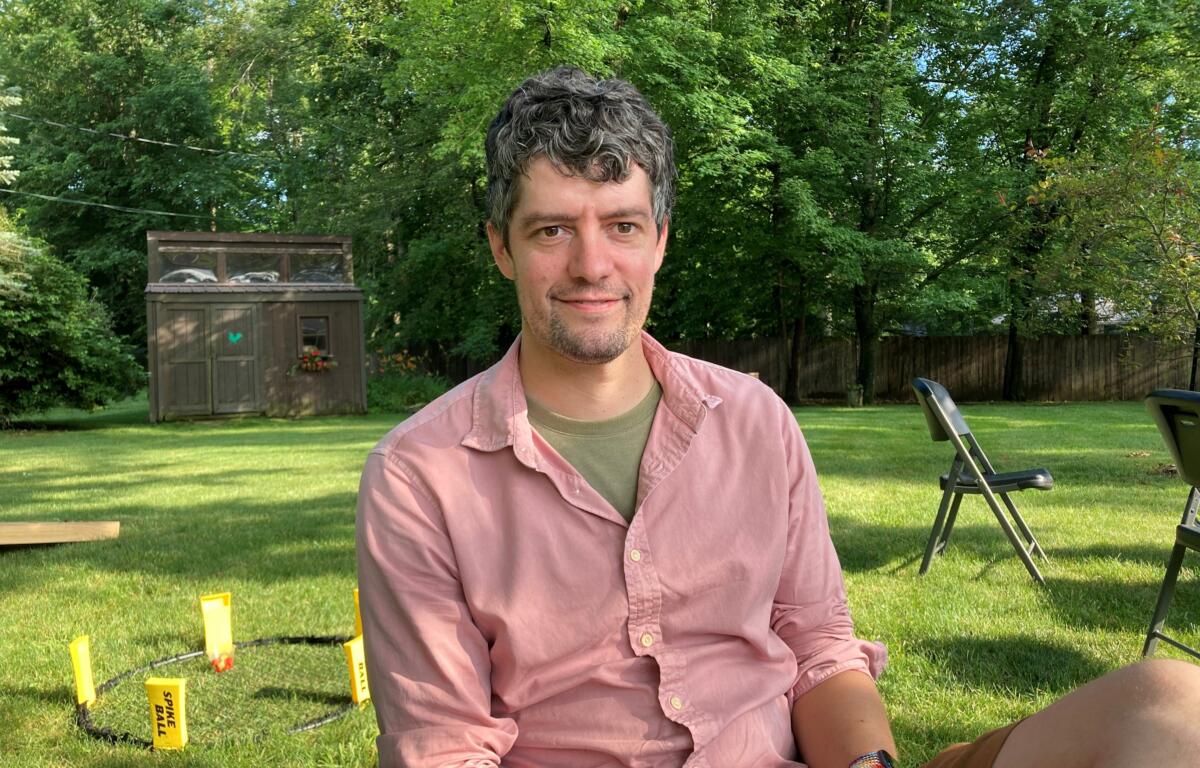


GALION – A Galion grad is carving a niche in the architectural world – one portfolio at a time.
Jonathan Junker, 39, has been designing upscale homes in the Seattle, Washington, area ever since he moved there after graduating from college. But the Galion native has also branched out into custom lighting – gleaming showpieces for hotels, museums, and office buildings around the world.
Junker calls them “sculptures.”
A 15-long floating “cloud” made from 15,000 ping pong balls hanging in the entrance of the Arts Museum in Bellevue, Washington. A fiberoptic fixture featuring 1,000 pendants in the Nordstrom flagship store in downtown Seattle. A custom LED-paneled ceiling in the lobby of Amazon’s headquarters there. And hundreds more “clouds” and custom pieces.
Although architecture has always been his primary career, Junker’s lighting designs evolved during a 10-year stint as the co-owner of Graypants, a company he and a former partner established in 2007 to produce scrap lights – laser-cut lamps literally crafted from corrugated cardboard. Graypants has offices in both Seattle and Amsterdam.
Their eco-chic pendant lights decorate Starbucks as well as countless cafes, hotels, and commercial buildings in more than 40 countries. “Decorative lighting was our bread and butter, but then it morphed into custom projects, custom lights for hotel lobbies, event centers, and other large-scale projects,” Junker said.
Also, at Graypants, Junker collaborated on transforming an old, abandoned garage on Vashon Island into a glowing lakeside cabin. A waterfront retreat mainly made of glass, featuring a folding glass wall that extends the living space out to a patio. The “garage” earned him the American Institute of Architects Honor Award for Washington state.
Junker, the son of Dennis and Mary Lou Junker of Galion, was destined to design. “He played with LEGOS from the time he could put them together, and quite honestly, he still does,” admitted his father. “I always said that’s what prompted him to become an architect. From a very, very, young age, his interest was always in building stuff.”
After graduating from Galion in 2000, Junker went on to earn a bachelor’s degree and an architectural degree from Kent State University in 2005. He had his sites on working in a big city – perhaps Chicago or Boston – until a favorite college professor at lunch one day suggested he explore the “progressive atmosphere” of downtown Seattle.
Junker said he interviewed with ten architectural firms in the seaport city. A month before graduation, he was offered a position at Stephen Sullivan Designs, a firm known for its “architecture as art” designs. “I was super excited. I came back to Ohio, finished my finals, and literally packed up my car.”
At Stephen Sullivan, Junker said he could pursue his passion for designing homes. “What I loved about it is it was really high-end residential.
Just the natural landscape of the houses on the water and the more sleek, modern buildings,” he said. “You can tell there’s a Pacific Northwest element to it. It’s a very distinct style.”
Four years later, he took his creative talents to another award-winning practice, world-renowned Olson Kundig Architects, and the blueprints went big-time. Contemporary homes in the Seattle area and multi-million-dollar mansions on the San Juan Islands, many featured in the pages of “Dwell” architectural magazine.
So far, Junker said, the highlight of his career hasn’t been one project, but rather the Millennial Entrepreneur of the Year award he received in 2016 from the U.S. Small Business Administration. The award recognized his achievements at Graypants and its partnership with the Dutch government for product distribution.
Two years ago, Junker said, he decided to sell his share in the lighting studio. Now he works in his own creative office on Bainbridge Island in Puget Sound, where he lives with his wife, Hana – also an architect – and daughters, Luna, 5, and 18-month-old Mila.
The architect extraordinaire has come back to his roots.
“I was profoundly influenced by diving into product design so deeply,” he said. “It was a really amazing experience. I think what’s really cool is in the end, after selling my half of the company, there’s a full-circle aspect of it. It’s influenced me as an architect in the end.”


