



By Krystal Smalley
ksmalley@wbcowqel.com
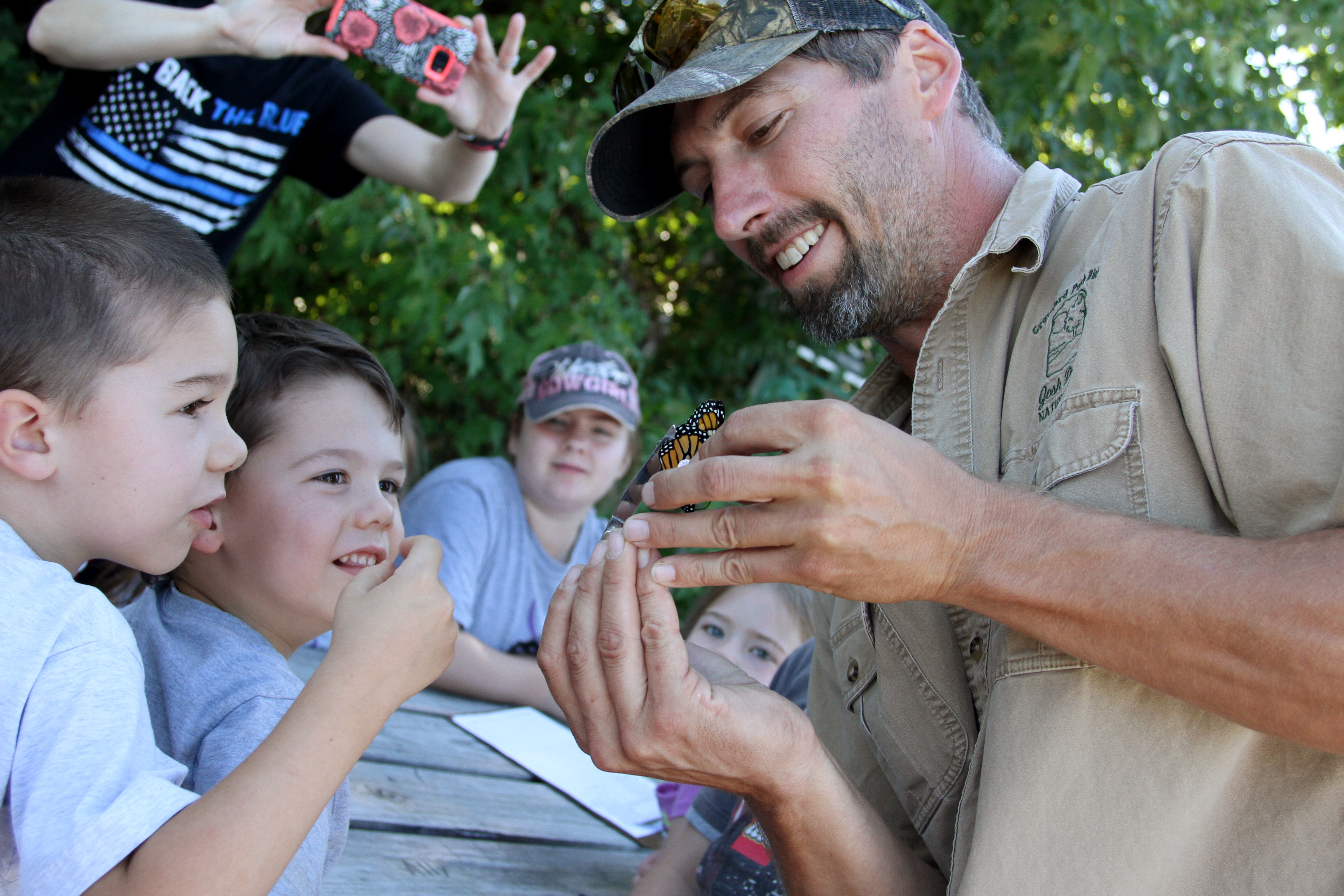
The sound of children’s laughter and the swish of nets filled Unger Park Monday as Crawford Park District Naturalist Josh Dyer led a monarch tagging expedition through the prairie.

Twelve kids listened intently as Dyer taught them the life cycle of the monarch butterfly, where butterflies get their food, and how they travel clear across North America to reach their wintering destination in Mexico.
“They go by the scads,” Dyer enthused, detailing how flocks of butterflies often land in the islands of Lake Erie after coming down from Canada before continuing their journey to a five-acre patch of land in Mexico. “They have one place in mind and that is the mountains of Mexico.”
Dyer brought two monarchs he raised himself to the program and demonstrated how to properly tag one and identify if they are male or female.
“Not only am I a nature nerd, but I’m a wannabe scientist, too,” Dyer joked with the kids as he helped them fill out a form on the butterfly’s details and tag that will be sent to the University of Kansas for further study on the species.

The two monarchs were later released into the wild as the children chanted, “gotta go, gotta go, gotta go to Mexico” to encourage the Monarch to fly off. Dyer, the kids, and their parents then traveled the paths of Unger Park in search of more monarchs to tag before the insects made their way to Mexico.
Christeena Smith and her mother Jo Smith wandered the Unger Park paths with Christeena’s daughter, Josslynn, and her nephew, Benjamin.
“We love butterflies and we’re all the time trying to plant as many flowers as we can to get them to come,” Christeena explained. “In April they went to Home Depot and built butterfly houses for Mother’s Day, but we’ve yet to get a butterfly.”
Despite not yet being able to attract a butterfly to their home, Benjamin was still full of monarch knowledge whenever Dyer asked a question. He quickly and correctly answered questions that seemed to stump the other kids.
“Awesome,” Benjamin said about the program. “I love nature.”

“We just want to be a part of it (the program), and teach them something about monarchs because they’re kind of going extinct and we want to know what we can do to help to keep them alive,” Christeena added. “I remember when I was little – like her age – and seeing monarchs everywhere. We don’t hardly see any now.”
“Monarch tagging helps researchers follow their migration, because the monarchs we’re seeing today,” Dyer said, “they’re going to fly to Mexico . . . Researchers are able to recover these tagged monarchs and figure out where they come from, which monarchs are coming from where.”
The Park District has been a part of the monarch tagging program since the 1990s and have had three of its tagged monarchs captured in Mexico.
“Monarchs themselves,” explained Dyer, “are up to be listed for the federally threatened, or endangered, because their numbers have been in such dramatic decline over the last decade that something needs to be done.”
Besides simply listing monarch butterflies as endangered, Dyer said Ohio has also created a pollinator initiative, which gets people concerned about monarchs or other pollinators to jump start them into planting pollinating-type flowers in their landscape to attract pollinators such as Monarchs or bees.
According to Dyer, the monarch population has been declining for a number of years due to a vast number of reasons. A drought in Texas, reduced pollination sources, and a reduction in habitat have affected the monarch population. Dyer said that the monarch’s overwintering area was reduced from roughly 40 acres down to five in the mountains of Mexico.
More information about the monarch tagging program can be found at www.monarchwatch.org.
PHOTO GALLERY: Monarch Tagging Program