



By Krystal Smalley
ksmalley@wbcowqel.com
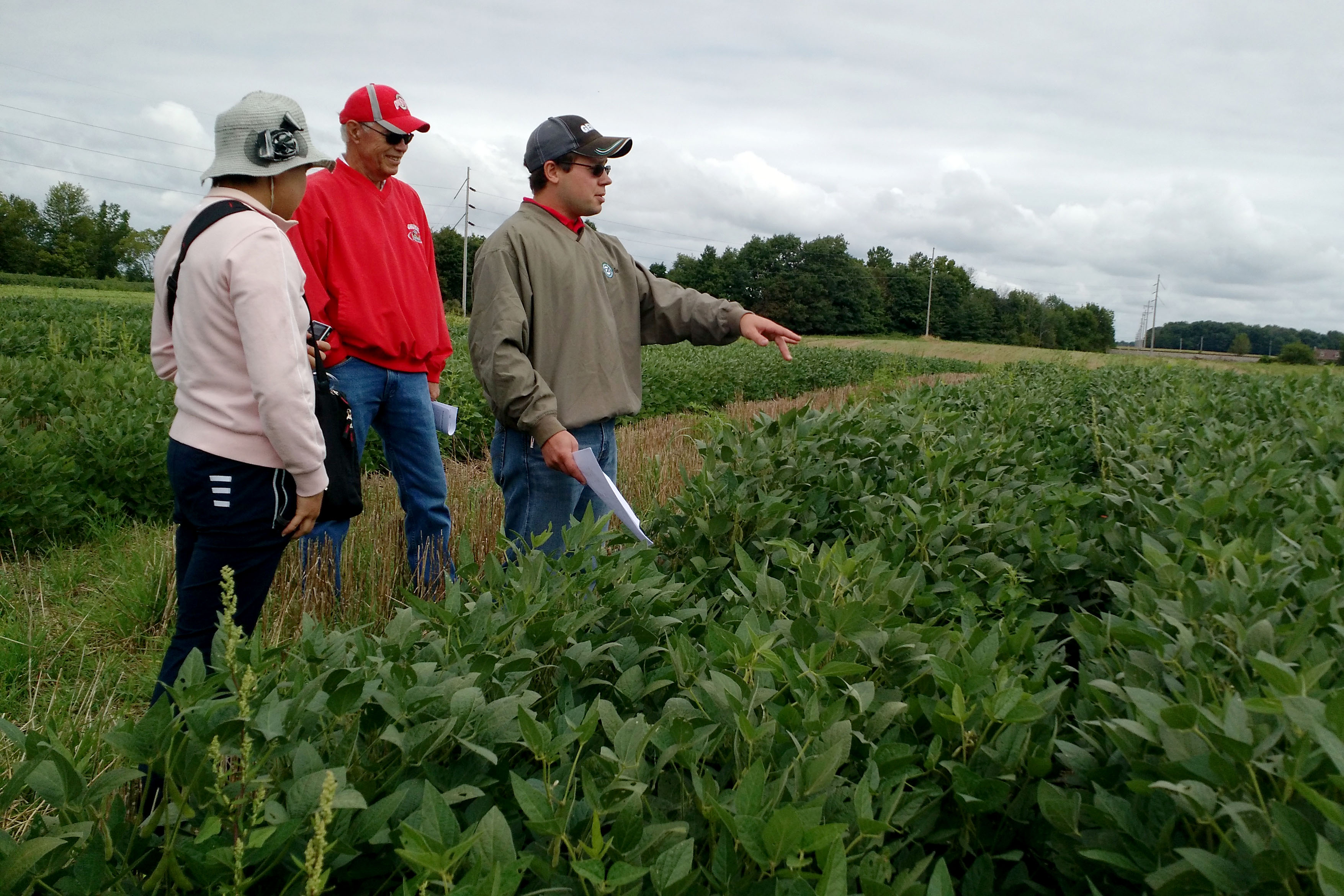
Eight acres of farmland in Crawford County was an area of interest for farmers curious in the benefits and research of intercropping.
The Crawford County Ohio State University Extension Office held a Modified Relay Intercropping Field Day at Unger Farm in Bucyrus Wednesday morning. Jason Hartschuh, the county’s agricultural and natural resources educator, and Steve Prochaska, an OSU Extension field specialist, discussed the research being done at Unger Farms with intercropping, soybean planting dates, maturity, and seeding rate.
The eight acres across from Unger Park and Unger Farm is planted with soybeans that have been planted at different dates with various row spacing and seed density. They are also interspersed with wheat.
 “We’ve grown essentially 100 bushel wheat in the MRI system. Ninety-nine is the top we’ve ever done,” Prochaska explained as he and Hartschuh reviewed trials completed in Crawford and Clark counties in 2014 and during multi-year trials with intercropping systems. “In my view it’s very reasonable to expect mid 70’s to low 80’s.”
“The one thing we switched to kind of looking at out here is planning dates and maturity of the soybeans that we put into the MRI,” Hartschuh said.
He hypothesized that if they could push their planting dates up, they will be able to come out with a higher year-over-year average in soybean yield.
“When you look at the 17-year average, two of those years are zeros on our soybean yield,” Hartschuh explained. “If we can push our planting date forward, we should hopefully eliminate our zero soybean yield because we’ll get them planted a little sooner, get a little more of that May moisture. Also, if we can plant a later season bean – a fuller-season bean – maybe we can accomplish that tail-end side and get late August moisture.”
Hartschuh hopes they will be able to average things out better that way. He cautioned, however, that farmers won’t see any advantage with an early maturing soybean.
“That actually may be a detriment,” Prochaska said, “because you really want those beans to be able to go through the normal periods in July and August that are dry and then have that ability to be able to continue to flower and pod later on. You don’t want them to be short.”
This year Hartschuh combined planting and maturity dates into one trial. He looked at seeding rate and MRI soybeans versus strips with no wheat. The MRI planting date was May 22 with a second planting date of June 5. Samples of the various soybean trials found that the June 5 planting date produced taller plants than the earlier May 22 date, something that was expected by Hartschuh and Prochaska.
 Prochaska has looked at Crawford County’s soybean averages and MRI yields for many years and he noted that there would be years with zero yields. That’s where he focused. The county yield average is between 42 and 43 bushel, Prochaska added.
“It was a function of planting date,” Prochaska explained. “The soybeans, when they start out to grow, their root system is more of a lateral . . . it doesn’t go down. And so they have to reach a stage of maturity before it starts to go down.”
When the soybeans were planted in early June, the weather conditions were not favorable and the soybeans never caught the moisture regime as the roots were going down, Prochaska clarified.
“Planting date is the big thing here with these soybeans,” Prochaska said. “You can see those are nice looking beans; there’s no doubt about it for this late planting date. The whole idea here is how can we modify this system to move up the planting date significantly?”
He cautioned, however, that there would also be a wheat trade-off.
“Without debate our wheat yields so far . . . are not up to par on the twin rows,” Prochaska said. “We’re going to keep pushing . . . If you’re going to be in this system here, if you’re going to wait until the middle of October to plant your wheat – don’t try it. Same with the soybeans. You’ve got to be after it when it’s time to go because you’ve really got to push the system.”